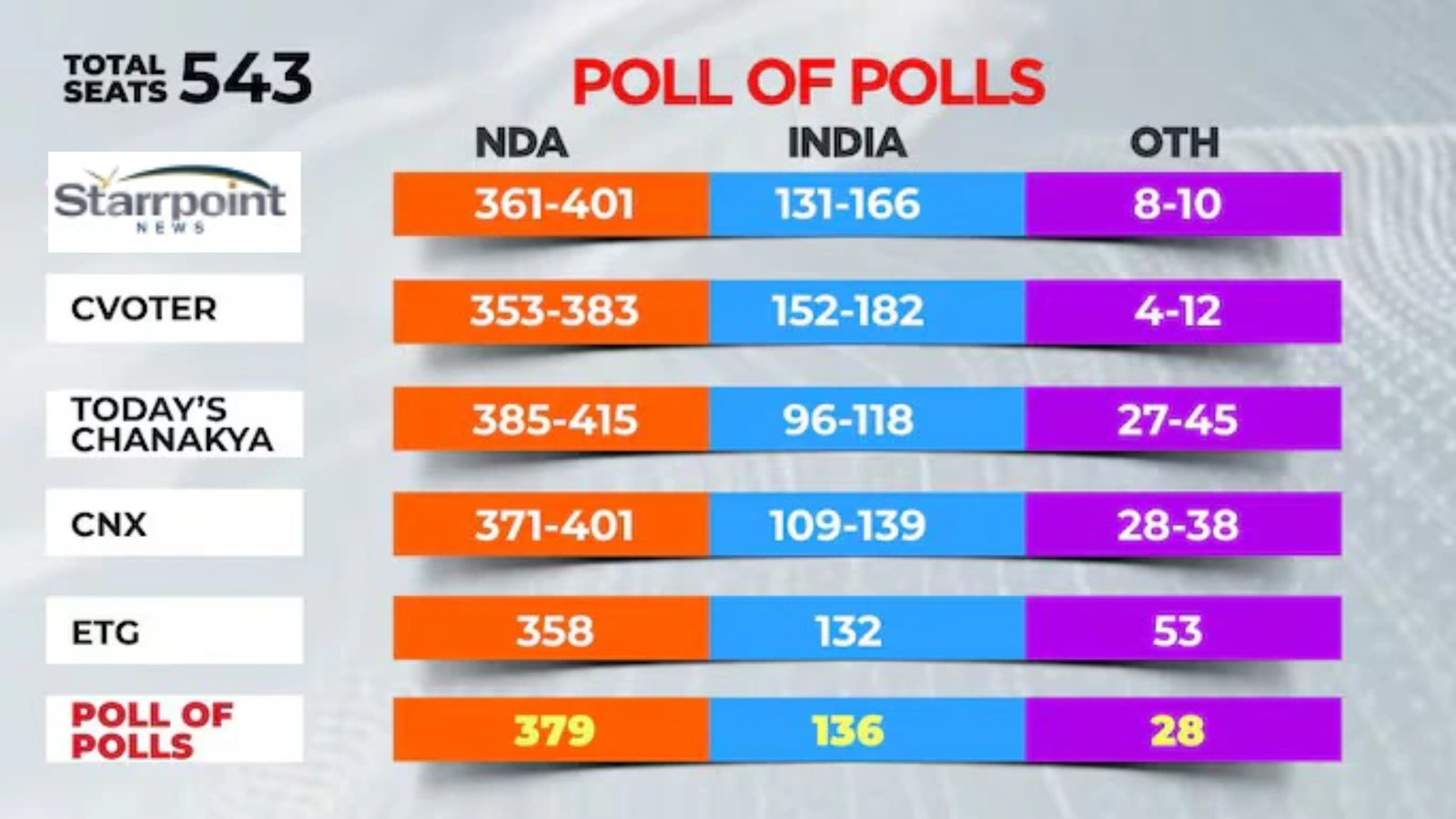
Poll of Polls: The election for the 243-seat Bihar Legislative Assembly has raised the political temperature to a new level this time. Voting took place in two phases on November 6 and 11, and as soon as voting ended, various survey agencies released exit polls.
These figures suggest that the National Democratic Alliance (NDA) could return to power with a majority. On the other hand, the situation looks bleak for the Grand Alliance (Grand Alliance).
If these warnings are found to be true, then once again NDA government is going to be formed in the state politics under the leadership of Nitish Kumar.
Voting and the electoral environment
Before we dive into the exit poll data, it’s important to understand what was going on in this election environment:
- The first phase of voting took place on 6 November and the second phase of voting concluded on 11 November in 122 assembly constituencies.
- Voter turnout has been impressive. For example, the second phase recorded a voter turnout of approximately 67.14 percent, considered an all-time high in the state.
- The high voter turnout had given all parties hope that the public was active and wanted change. But now exit polls indicate that the way the public voted has resulted in a majority for the NDA.
Exit poll figures
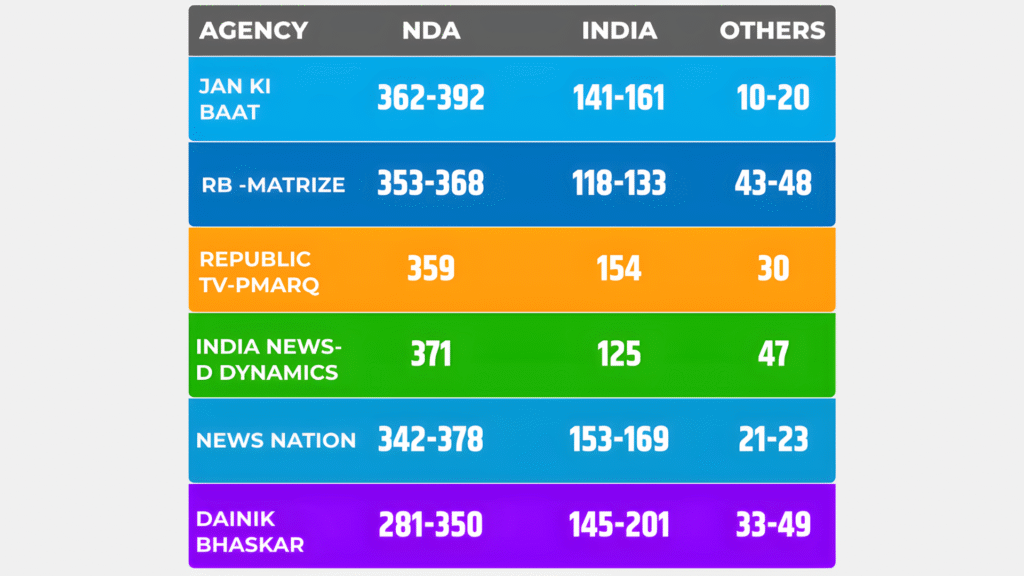
Exit polls show the NDA gaining a clear lead. Below is a detailed table containing projections from major survey agencies:
Note: A majority requires 122 seats. The NDA appears to be very clearly crossing this mark in these trends.
| survey agency | NDA Estimated Seats | Grand Alliance Estimated Seats | Other parties/faction estimated seats |
|---|---|---|---|
| Matrize-IANS | 147 – 167 seats | 70 – 90 seats | 2 – 10 seats |
| Dainik Bhaskar | 145 – 160 seats | 73 – 91 seats | 5 – 10 seats |
| Chanakya Strategies | 130 – 138 seats | 100 – 108 seats | 3-5 seats |
| People’s Pulse | 133 – 159 seats | 75 – 101 seats | 2 – 13 seats |
| People’s Insight | 133 – 148 seats | 87 – 102 seats | 3 – 6 seats |
| JVC Polls | 135 – 150 seats | 88 – 103 seats | 3 – 6 seats |
Why is NDA leading?
The major NDA parties, the BJP, the Janata Dal (United) (JAYDU), and other smaller factions, have maintained a balanced alliance. This has strengthened the alliance and is believed to have reduced vote bank division.
The Grand Alliance was expected to bring an agenda of change, but exit polls suggest it hasn’t achieved that momentum. Some surveys suggest that the new party, the Jan Suraj Party (founded by Prashant Kishor), has been underwhelmed by the public, with various surveys estimating its performance to be between 0 and 5 seats.
The high voter turnout also indicated an active public and widespread participation. This raised the possibility of changing old political patterns, but the public did not let the trust in the old coalition be broken this time.
Why does the Grand Alliance seem to be lagging behind?
While the Grand Alliance promised change, exit polls suggest their voice didn’t resonate enough. The NDA had a better message and organizational support than the opposition alliance.
The entry of the Jan Suraj Party was a major talking point in this election. However, surveys suggest that it faces a difficult win, diminishing its chances of bringing about change in the opposition.
The Grand Alliance comprised various parties, but seat allocation, seat allocation, and vote bank integration remained challenges. Furthermore, the NDA ensured balance among its internal parties.
READ ALSO:- UPMSP 2026 || Exams Time and Major updates
Is “Nitish’s comeback” really happening?
If the exit polls prove accurate, which have been fairly consistent across various sources so far, Bihar could once again see the NDA government under Nitish Kumar’s leadership. This means that the previous administration’s experience, coalition strategy, and vote bank balance have paid off.
But it’s important to note that exit polls aren’t results, but rather indications of where the public is leaning. As in previous elections (for example, in 2024), polls have sometimes given different results, so we’ll have to wait until the actual results come out on November 14th.
Future challenges and perspectives
Counting of votes will take place on November 14th, and until then, uncertainty over the outcome will persist. Polls have provided some indication, but the true picture will emerge only after the EVM count is complete.
If the NDA wins enough seats, seat-sharing within the alliance, cabinet formation, and strategic decisions will emerge, especially the balance between the JDU and the BJP.
If the grand alliance wins far fewer seats than expected, it will have to introspect where its strategy and communication failed. Their leadership of future political change could be affected.
Now that exit polls indicate that the NDA has an edge, public expectations will also increase after the formation of the government and the responsibility to fulfill promises like development, employment, law and order will immediately increase.
Conclusion
Thus, exit polls for the 2025 Bihar Assembly elections indicate that the NDA is poised to return to power once again. The Grand Alliance appears to be lagging behind, while the new party, Jan Suraj, appears unlikely to achieve significant success. However, exit polls are merely indications; the actual results will be revealed on November 14th. If the predictions prove correct, a new government will be formed in Bihar, carrying new responsibilities and public expectations. However, major changes are always possible in the political game, so comments will be made only after seeing the actual results.