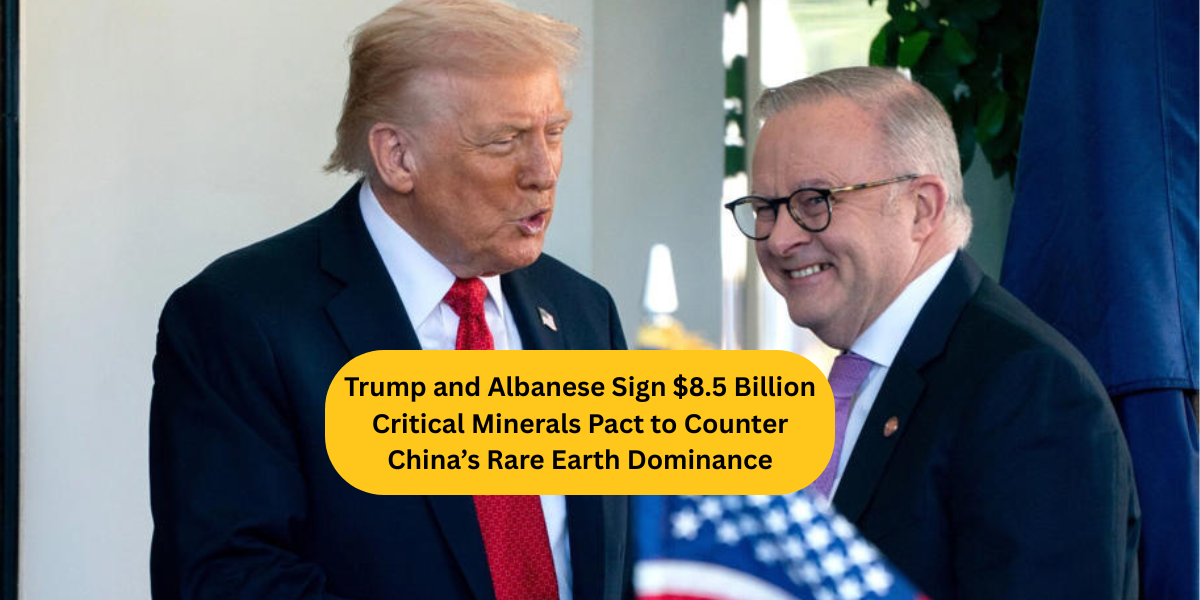
President Donald Trump and Australian Prime Minister Anthony Albanese have signed a historic agreement to strengthen US-Australia cooperation on key minerals and rare earths. The agreement aims to reduce both countries’ dependence on Chinese supply chains, which play a key role in global manufacturing.
The $8.5 billion agreement establishes a new framework for the exploration, processing, and export of rare earths, critical for the defense, energy, and technology industries.
A strategic alliance to secure supply chains
At a joint press conference at the White House, Trump described the agreement as a turning point in American resource independence.
“In about a year, we’ll have so many key minerals and rare earths that you won’t know what to do with them,” Trump declared. He emphasized his administration’s focus on building domestic reserves and reducing foreign vulnerabilities.
Prime Minister Albanese described the agreement as “an $8.5 billion pipeline ready” and called it a major step forward in cooperation between the two countries, both economically and defensively.
Under the new framework, Australia will expand its processing capacity for rare earths (materials used in semiconductors, electric vehicles, and missile guidance systems), while the United States will provide financing, technology transfer, and defense-related investment.
Details of the Critical Minerals Deal
According to the agreement released by Albanese’s office, both governments have committed to investing more than $1 billion each over the next six months to finance initial projects. A joint venture with Japan is also planned, which will strengthen trilateral cooperation in the processing of critical minerals.
The Pentagon will finance the construction of a 100 metric ton per year gallium refinery in Western Australia, which will be the first major US-funded facility of its kind outside North America. Additionally, the US Export-Import Bank (EXIM) has issued expressions of interest totaling $2.2 billion in potential financing for related projects.
Leaders have pledged to protect domestic industries from unfair trade practices, including establishing shared standards, including a “price floor or equalization mechanism,” to stabilize the global rare earth market.
Why Rare Earth Elements Are Important
Rare earth elements—a group of 17 metals—are essential for modern technology, whether it’s smartphones, wind turbines, fighter jets, and satellite systems. China currently controls more than 70 percent of the world’s rare earth processing capacity, giving Beijing significant influence over global supply and pricing.
Recent export restrictions imposed by China have raised concerns in Washington and its allies about potential economic pressure. The US Treasury and Defense departments have increasingly emphasized source diversification, and have identified Australia as a key strategic partner for its vast reserves and stable political environment.
Australia ranks fourth globally in rare-earth deposits, with significant output from Lynas Rare Earths Ltd., the only major producer of “heavy” rare earths outside China
Australia’s Economic Opportunity
For Canberra, the deal represents both a diplomatic victory and an economic opportunity. Albanese, who has sought to balance relations between Washington and Beijing, stressed that Australia is ready to expand manufacturing capacity and attract long-term investment.
Albanese said, “This agreement will take our cooperation to the next level. It further strengthens our role as a reliable supplier of critical resources that power the modern economy and defense capabilities.”
Australian Finance Minister Jim Chalmers recently met with investors from Blackstone Inc. and Blue Owl Capital in New York to promote Australian mining projects. Officials said the government wants to establish the country as a “reliable source” for global capital seeking to diversify away from China.
Amid growing investor confidence in US-Australia cooperation, shares of mining companies like Lynas have surged more than 150 percent over the past year.
US Strategic and Defense Implications
For the US, this agreement extends beyond resource economics. It directly relates to national security planning. The Department of Defense has long warned that China’s dominance in rare earth processing represents a strategic weakness, especially for advanced weapons systems that rely on these materials.
The Trump administration views this new agreement as part of a larger effort to “reindustrialize America” and link critical supply networks with allies rather than strategic competitors.
A senior White House official said, “This agreement isn’t just about mineral resources. It’s intended to ensure that our allies have everything they need to defend themselves—and ours.”
Renewed emphasis on defense cooperation
In addition to rare earth minerals, Trump and Albanese discussed a number of defense initiatives, including submarine sales, underwater drones and Apache helicopter deliveries.
Australia has agreed to buy $1.2 billion worth of underwater drones and $2.6 billion worth of Apache attack helicopters as part of its defense-modernization plan. The White House confirmed that talks are also underway to expedite the delivery of five nuclear-powered Virginia-class submarines by the early 2030s.
The transactions fall under the broader AUKUS agreement, which was originally signed in 2021 to counter Chinese military expansion in the Indo-Pacific. While the Trump administration has launched a policy review of AUKUS to ensure it is consistent with its “America First” agenda, Trump indicated on Monday that the agreement will continue:
“We’re doing it,” the president said. “We have the best submarines in the world, and now we’re building more — complete with Anthony.”
Economic tensions remain
Despite strong defense and resource ties, trade tensions remain. Australia has sought relief from U.S. tariffs, including Trump’s reinstatement of a 10 percent tariff on Australian goods as part of his broader trade policy overhaul.
Trump has commented, “Australia pays very low tariffs—very, very low tariffs,” and has also signaled that further concessions are unlikely.
Analysts say Albanese faces the challenge of striking a delicate balance: deepening security and economic ties with the United States while maintaining his country’s largest trading relationship with China.
The Australian leader has visited Beijing twice since taking office, suggesting that Canberra still views economic engagement with China as important. Still, this new mineral deal demonstrates growing strategic trust with Washington.
Expert Reactions and Market Implications
Energy and defense analysts have hailed the deal as a major milestone in global resource diversification.
Dr. Karen Middleton, a senior fellow at the Lowy Institute, said the deal could “reshape the geopolitical map of resource supply chains.”
“The United States and Australia are effectively creating an ecosystem parallel to China’s dominance,” she explained. “This will have long-term implications for energy transition, defense manufacturing, and even emerging sectors like artificial intelligence and quantum computing.”
Market observers also believe that the commitment of both the Pentagon and Exim Bank to co-finance projects gives the initiative extraordinary credibility. Bloomberg Intelligence analyst Peter Nguyen said such moves “indicate Washington’s importance” in building non-Chinese supply resilience.
Following the announcement, shares of companies involved in lithium, cobalt and rare-earth mining rose sharply, reflecting investor optimism about new financing channels.
Geopolitical Context
China’s decision earlier this year to limit exports of gallium and germanium, used in advanced semiconductors, underscores the urgency of creating alternative supply routes. The new US-Australia deal directly addresses this vulnerability.
Finance Minister Scott Bessant confirmed last week that the US and its allies are coordinating a “joint response” to China’s export controls. This latest agreement is expected to form the cornerstone of that joint strategy.
The initiative is also consistent with Trump’s broader “Energy Dominance 2.0” agenda, which aims to expand domestic production of clean energy components critical to American independence, not just fossil fuels.
“The essential mineral is the oil of the 21st century,” Bessant said in a statement. “This partnership ensures that the United States and our allies will retain control over our future energy and defense capabilities.”
Challenges Ahead
Despite this optimism, industry experts warn that building a rare-earth supply chain outside of China is complex and capital-intensive. Processing facilities take years to build and face stringent environmental regulations.
While Australia has reserves, most refining technology remains in Asia, meaning close coordination and technology transfer will be essential.
Mining-policy expert Dr. Michael Baker of the University of Melbourne warns that “the results will not be immediate.”
“It’s a long game. Even with strong political will, it could take five to 10 years to establish a fully independent processing ecosystem,” Baker said.
Nevertheless, analysts agree that the deal will lay the foundation for a lasting strategic alliance in the Indo-Pacific region’s crucial mineral competition.
Looking ahead
Both leaders have indicated that more announcements are imminent. Officials are already working on joint research initiatives, battery-supply innovations, and standardized environmental protocols to ensure sustainable mining practices.
Conclusion
The U.S.–Australia critical-minerals agreement marks one of the most significant developments in allied industrial cooperation since the creation of AUKUS. It represents a strategic response to China’s market dominance and a long-term investment in supply-chain security.
While challenges remain in implementation, the accord underscores the shared determination of Washington and Canberra to protect their economic and defense interests in an increasingly competitive global environment.
As President Trump put it:
“This is just the beginning. The United States and Australia are building the future together — strong, independent, and unstoppable.”